
CBSE CLASS 12TH GEOGRAPHY PAPER 2026//SOLUTION
.png)
Read the following instructions carefully:
(i) This question paper contains 30 questions. All questions are compulsory.(ii) Question paper is divided into five sections – Sections A, B, C, D and E.
(iii) Section A – Question no. 1 to 17 are Multiple Choice Type Questions. Each question carries 1 mark.
(iv) Section B – Questions no. 18 and 19 are Source-based Questions. Each question carries 3 marks.
(v) Section C – Questions no. 20 to 23 are Short Answer Type Questions. Each question carries 3 marks. Answer to these questions shall be written in 80 to 100 words.
(vi) Section D – Questions no. 24 to 28 are Long Answer Type Questions. Each question carries 5 marks. Answer to these questions shall be written in 120 to 150 words.
(vii) Section E – Questions no. 29 and 30 are Map-based Questions. Each question carries 5 marks.
(viii) In addition to this, note that a separate question has been provided for Visually Impaired Candidates in lieu of questions having visual inputs, map etc. Such questions are to be attempted by Visually Impaired Candidates only.
(ix) There is no overall choice given in the question paper. However, an internal choice has been provided in a few questions in all sections other than Section A and B.
(iii) Section A – Question no. 1 to 17 are Multiple Choice Type Questions. Each question carries 1 mark.
(iv) Section B – Questions no. 18 and 19 are Source-based Questions. Each question carries 3 marks.
(v) Section C – Questions no. 20 to 23 are Short Answer Type Questions. Each question carries 3 marks. Answer to these questions shall be written in 80 to 100 words.
(vi) Section D – Questions no. 24 to 28 are Long Answer Type Questions. Each question carries 5 marks. Answer to these questions shall be written in 120 to 150 words.
(vii) Section E – Questions no. 29 and 30 are Map-based Questions. Each question carries 5 marks.
(viii) In addition to this, note that a separate question has been provided for Visually Impaired Candidates in lieu of questions having visual inputs, map etc. Such questions are to be attempted by Visually Impaired Candidates only.
(ix) There is no overall choice given in the question paper. However, an internal choice has been provided in a few questions in all sections other than Section A and B.
SECTION A
Question nos. 1 to 17 are Multiple Choice Type Questions. 17 × 1 = 17
1. Which of the following is one of the main objectives of ‘human development’? Choose the most appropriate option.
(A) Long life
(B) Healthy life
(C) Wealthy life
(D) Meaningful life
ANSWER:- Correct Answer: (D) Meaningful life
📌Explanation (Exam point of view):
📍The concept of human development, as emphasized by the United Nations Development Programme, focuses on improving the quality of human life, not just income or wealth. It includes:
📌Living a long and healthy life
📌Being educated
📌Having access to resources
📌Leading a meaningful and dignified life
🖋️Among the options, “meaningful life” is the most comprehensive and appropriate objective of human development.
2. Which of the following aspects are true regarding the countries with low level of human development? Choose the most appropriate option.
I. These countries are largely facing political turmoil.
II. These countries are facing social instability.
III. The number of countries in the low level category is the largest.
IV. The health status of the people of these countries is poor.
Options:
(A) Only I, II and III are correct.
(B) Only I, II and IV are correct.
(C) Only I, III and IV are correct.
(D) Only II, III and IV are correct.
Answer: (B) Only I, II and IV are correct
Low human development countries often face political instability (I) and social problems (II).
They also have poor health conditions (IV).
Statement III is incorrect because most countries fall in the medium category, not low.
Low human development countries often face political instability (I) and social problems (II).
They also have poor health conditions (IV).
Statement III is incorrect because most countries fall in the medium category, not low.
3. Which one of the following types of ports is categorised on the basis of function?
(A) Out port
(B) Oil port
(C) Inland port
(D) Comprehensive port
Answer: (B) Oil port
Ports classified by function include oil ports, naval ports, fishing ports, etc.
“Out port” and “inland port” are based on location, not function.
Ports classified by function include oil ports, naval ports, fishing ports, etc.
“Out port” and “inland port” are based on location, not function.
4. Which of the following are the true characteristics of cottage manufacturing? Choose the most appropriate option.
I. The artisans use local raw materials.
II. The products of these units are supplied at distant markets.
III. Most of the times, the family members work in these units.
IV. The finished products like mats, bricks, pottery, etc. are some important examples.
Options:
(A) Only I, II and III are correct.
(B) Only I, III and IV are correct.
(C) Only I, II and IV are correct.
(D) Only II, III and IV are correct.
Answer: (B) Only I, III and IV are correct
Cottage industries:
Use local raw materials (I)
Run by family labour (III)
Produce items like mats, pottery (IV)
Statement II is wrong because products are usually sold in local markets, not distant ones.
Cottage industries:
Use local raw materials (I)
Run by family labour (III)
Produce items like mats, pottery (IV)
Statement II is wrong because products are usually sold in local markets, not distant ones.
5. Which of the following is a product of forest-based industry?
(A) Leather
(B) Tea
(C) Cotton
(D) Paper
Answer: (D) Paper
Paper is made from wood pulp, a forest resource.
Leather, tea, and cotton are not forest-based industries.
Paper is made from wood pulp, a forest resource.
Leather, tea, and cotton are not forest-based industries.
6. Which of the following factors are involved in large-scale manufacturing? Choose the most appropriate option.
I. Variety of raw material
II. Advanced technology
III. Semi-skilled worker
IV. Large investment
Options:
(A) Only I, II and III are correct.
(B) Only I, III and IV are correct.
(C) Only I, II and IV are correct.
(D) Only II, III and IV are correct.
Answer: (C) Only I, II and IV are correct
Large-scale manufacturing requires:
Variety of raw materials (I)
Advanced technology (II)
Large investment (IV)
Semi-skilled workers (III) are more typical of small-scale industries.
Large-scale manufacturing requires:
Variety of raw materials (I)
Advanced technology (II)
Large investment (IV)
Semi-skilled workers (III) are more typical of small-scale industries.
7. Which one of the following is not the base of ‘international trade’?
(A) Differences in national resources
(B) Stage of economic development
(C) Level of transport development
(D) Social diversity in the country
Answer: (D) Social diversity in the country
International trade depends on:
Resource differences
Development level
Transport facilities
Social diversity is not a direct base.
International trade depends on:
Resource differences
Development level
Transport facilities
Social diversity is not a direct base.
8. Match Column I with Column II correctly and choose the most appropriate option:
Column I (Type of Port). Column II (Example)
a. Packet station. i. Kochi
b. Naval port. ii. Copenhagen
c. Port of call. iii. Dover
d. Entrepot port. iv. Honolulu
Options:
(A) a-iii, b-i, c-iv, d-ii
(B) a-iii, b-i, c-ii, d-iv
(C) a-i, b-ii, c-iii, d-iv
(D) a-i, b-ii, c-iv, d-iii
Answer: (A) a-iii, b-i, c-iv, d-ii
Packet station → Dover (iii)
Naval port → Kochi (i)
Port of call → Honolulu (iv)
Entrepot port → Copenhagen (ii)
Packet station → Dover (iii)
Naval port → Kochi (i)
Port of call → Honolulu (iv)
Entrepot port → Copenhagen (ii)
9.During which one of the following decades, the population growth in India was negative?
(A) 1911 to 1921
(B) 1931 to 1941
(C) 1951 to 1961
(D) 1971 to 1981
Answer: (A) 1911 to 1921
This decade is known as the “Great Divide” in India’s population history.
Population declined due to famine, epidemics, and World War effects.
10. Which of the following set of states have the lowest percentage of urban population?
(A) Madhya Pradesh and Kerala
(B) Punjab and Gujarat
(C) Goa and Maharashtra
(D) Bihar and Himachal Pradesh
Answer: (D) Bihar and Himachal Pradesh
Both states have low urbanisation levels compared to others listed.
11. Which one of the following set of places are connected by the ‘Atal Tunnel’?
(A) Shimla and Manikaran
(B) Shimla and Lahaul-Spiti
(C) Manali and Lahaul-Spiti
(D) Manali and Manikaran
Answer: (C) Manali and Lahaul-Spiti
The Atal Tunnel connects Manali to Lahaul-Spiti, providing all-weather connectivity.
12. Which one of the following organisations constructed the Hazira-Vijaipur-Jagdishpur gas pipeline?
(A) Hindustan Petroleum Corporation
(B) Oil and Natural Gas Corporation
(C) Oil Authority of India Limited
(D) Gas Authority of India Limited
Answer: (D) Gas Authority of India Limited
The HVJ pipeline was built by Gas Authority of India Limited (GAIL).
13. The Watershed Management Programme in Jhabua district of Madhya Pradesh was funded by which one of the following ministries?
(A) Ministry of Agriculture
(B) Ministry of Urban Development
(C) Ministry of Human Development
(D) Ministry of Finance
Answer: (A) Ministry of Agriculture
Watershed programmes are mainly related to land and water resource management, handled by the agriculture ministry.
Watershed programmes are mainly related to land and water resource management, handled by the agriculture ministry.
14. Which one of the following has classified ‘wastelands’ in India?
(A) Indian Space Research Organisation
(B) Indian Institute of Remote Sensing
(C) Regional Remote Sensing Centres
(D) National Remote Sensing Centre
Answer: (D) National Remote Sensing Centre
National Remote Sensing Centre (NRSC) classified wastelands using satellite data.
National Remote Sensing Centre (NRSC) classified wastelands using satellite data.
Based on the table provided in the image, here are the answers to questions 15, 16, and 17.
15. Which one of the following countries is ranked the best in Human Development Index?
The "best" rank refers to the highest HDI value. Looking at the options provided:
(A) Bhutan: 0.681
(B) Bulgaria: 0.799
(C) Mauritius: 0.796
(D) Singapore: 0.949
Correct Option: (D) Singapore
16. Arrange the following countries in descending order of their HDI and choose the correct option.
Descending order means from highest value to lowest value.
Sweden (III): 0.952
Singapore (II): 0.949
Mauritius (I): 0.796
Venezuela (IV): 0.699
The sequence is III, II, I, IV.
Correct Option: (C) III, II, I, IV
17. Which continent has the highest number of countries in the given table?
Let’s categorize each country by its continent:
Bhutan: Asia
Bulgaria: Europe
Mauritius: Africa
Singapore: Asia
Sweden: Europe
Venezuela: South America
(19.1) Describe the main cause of water pollution.
Bhutan: Asia
Bulgaria: Europe
Mauritius: Africa
Singapore: Asia
Sweden: Europe
Venezuela: South America
Section 19: Water Pollution
Based on the passage provided, here are the answers to the sub-questions:(19.1) Describe the main cause of water pollution.
The passage indicates that water pollution is primarily caused by contaminated water. While the text mentions river pollution is common across all rivers in India, it highlights that pollution in the river Ganga is a major concern because it flows through some of the most populous regions of India, implying that human activities and population density are significant contributors.
(19.2) Mention any two features of the Namami Gange Programme.
The Namami Gange Programme (National Mission for Clean Ganga) was launched with the following objectives:
Pollution Abatement: To effectively reduce the pollution of the river Ganga.
Conservation and Rejuvenation: To protect and restore the ecological health and water quality of the river.
(19.3) Explain the impact of water pollution on human health.
Water pollution is a major source of water-borne diseases. According to the passage, approximately one-fourth of all communicable diseases in India are water-borne. Common illnesses include:
Diarrhoea
Intestinal worms
Hepatitis
SECTION C
20. Explain the concept of 'neo-determinism'.
Neo-determinism, a concept introduced by Griffith Taylor, represents a middle path between environmental determinism and possibilism.
It suggests that while humans can modify their environment, they cannot completely ignore the laws of nature.
It is often described as "Stop and Go Determinism"—much like a traffic light, nature sets limits (red light), and humans can only progress (green light) when they respect those natural boundaries.
The goal is to achieve sustainable development without causing environmental damage like global warming or ozone depletion.
Question 21
Explain the main characteristics of Stage I of the Demographic Transition Theory on the bases of birth rate, death rate, and growth of population.
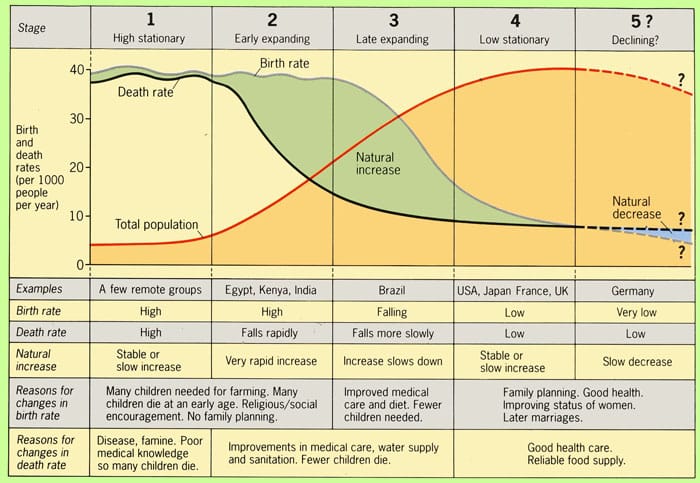
the "Demographic Transition Theory" diagram, Stage I (the High Stationary stage) is characterized by the following:
Birth Rate (BR): It is very high (around 35 per 1,000 population). This is often due to a lack of family planning and the high social value placed on large families.
Death Rate (DR): It is also very high and fluctuates significantly. High death rates are usually caused by poor sanitation, lack of medical facilities, and food insecurity.
Growth of Population: Because both birth and death rates are high and roughly equal, the natural increase in population is very low. The population growth remains stable or grows very slowly.
The following question is for the Visually Impaired Candidates only in lieu of Question No. 21.Explain the main characteristics of 'demographic cycle'.
Ans:-Explain the main characteristics of ‘demographic cycle’. (3 Marks)
The demographic cycle (or Demographic Transition Theory) describes the stages of population change that a society goes through as it transforms from a rural, agrarian, and illiterate society to an urban, industrial, and literate one.
Main Characteristics:
Three-Stage Progression: It generally moves through three stages:
Stage I (High Fluctuating): High birth rates and high death rates. Population growth is slow. People are mostly engaged in agriculture and have low life expectancy.
Stage II (Expanding): Death rates fall rapidly due to improved sanitation and health, but birth rates remain high. This leads to a "population explosion."
Stage III (Low Fluctuating): Both birth and death rates decline significantly. The population becomes stable or grows slowly. The society becomes urbanized and technologically advanced.
Socio-Economic Link: The cycle shows that population change is directly linked to the level of economic development and literacy.
22.
(a) "The adolescent people of India have high potential but they are quite vulnerable." Explain the statement.
Ans:-a): “The adolescent people of India have high potential but they are quite vulnerable.” Explain the statement. (3 Marks)
High Potential:
Human Capital: Adolescents (aged 10–19) constitute about one-fifth of India's population. They are the future workforce and can drive economic growth if properly trained.
Innovation: They are more adaptable to new technologies and can lead social and digital transformations.
Vulnerability:
Health Risks: They face challenges like malnutrition (especially anemia in girls), substance abuse (drugs/alcohol), and high risk of HIV/AIDS.
Social Challenges: High rates of school dropouts, early marriage (especially in rural areas), and lack of proper guidance or vocational skills lead to unemployment or low-wage labor.
OR
(b) "The Indian government formulated the National Policy for Skill Development." Explain the need for the policy.
Ans The Indian government formulated the National Policy for Skill Development.” Explain the need for the policy. (3 Marks)
The National Policy for Skill Development and Entrepreneurship was formulated to address several critical gaps:
Bridging the Skill Gap: To align the skills of the youth with the actual requirements of the industry, as many graduates were found to be "unemployable."
Economic Growth: To empower the large "demographic dividend" of India to contribute to the GDP and make India the "skill capital" of the world.
Promoting Entrepreneurship: To encourage youth to become job creators rather than just job seekers by providing credit and market support.
23. Explain the characteristics of clustered rural settlements in India.
Ans:-Explain the characteristics of clustered rural settlements in India. (3 Marks)
Clustered (or Nucleated) settlements are characterized by a compact and closely built-up area of houses.
Key Characteristics:
Compact Structure: Houses are built very close to each other, separated by narrow, winding lanes. There is a distinct living area separated from the surrounding farms and pastures.
Social Grouping: These settlements are often organized along social or ethnic lines. The main land-owning communities live in the center, while lower-status groups or laborers live on the fringes.
Common in Fertile Areas: They are most commonly found in the fertile alluvial plains (like the Indo-Gangetic plain) and in the valleys of North-East India, where security and defense (or water availability) require people to live close together.
SECTION D
Question nos. 24 to 28 are Long Answer Type Questions. 5×5=25
24. "Quaternary activities are based on specialised knowledge and skill." Justify the statement by giving suitable arguments. 5
Answer:-Quaternary activities are based on specialised knowledge and skill." Justify the statement by giving suitable arguments.
Quaternary activities represent a highly advanced sector of the economy focused on the "knowledge sector." The statement is justified by the following arguments:
Specialised Knowledge: Unlike primary or secondary sectors, quaternary activities revolve around the creation, collection, and dissemination of information. This includes research and development (R&D), financial planning, and tax consulting.
High Level of Skill: These roles require workers with high levels of education and technical expertise, often referred to as "gold-collar" workers.
Innovation-Driven: This sector is responsible for technological breakthroughs and innovation that drive efficiency in other sectors of the economy.
Professional Services: It includes specialised services like legal consultancy, software development, and administrative services that require specific certifications and training.
Independent of Raw Materials: Unlike manufacturing, these activities are not tied to resource locations; they thrive in areas with high intellectual capital and advanced telecommunications.
25. (a) "Roads play a vital role in trade and commerce of a country across the world." Support the statement with examples.5
Answer:-Roads play a vital role in trade and commerce of a country across the world." Support the statement with examples.
Roads are the backbone of a country's internal trade and a key link to international commerce.
Door-to-Door Service: Roads provide the unique advantage of door-to-door delivery, which is essential for the distribution of goods to retail markets and final consumers.
Feeder to Other Modes: They act as feeders to railways, ports, and airports, moving goods from production centers to shipment hubs.
Perishable Goods: Roads are ideal for transporting perishable items like milk, fruits, and vegetables over short distances quickly.
Accessibility: They reach remote and mountainous areas where other modes of transport (like rail) are difficult or impossible to build.
Example: In India, the Golden Quadrilateral connects major industrial and agricultural hubs, significantly reducing travel time and boosting trade efficiency between cities like Delhi, Mumbai, Chennai, and Kolkata.
OR
(b) "Railways are a mode of land transport for bulky goods and passengers over long distances in the world." Support the statement with examples.
Answer:-Railways are a mode of land transport for bulky goods and passengers over long distances in the world." Support the statement with examples.
Railways are essential for large-scale movement across vast geographical areas.
Heavy and Bulky Loads: Railways are the most cost-effective way to transport heavy raw materials like coal, iron ore, and timber over long distances.
Mass Passenger Transport: They facilitate the movement of thousands of people simultaneously, making them vital for labor migration and tourism.
Integration of Markets: Railways help in integrating national markets by connecting distant production centers to consumption points.
Example: The Trans-Siberian Railway in Russia is the longest in the world, connecting European Russia with the Russian Far East, proving vital for both resource transport and passenger travel across a continent.
26.
(a) "Metro rail has revolutionised the urban transport system in India." Support the statement with examples
Answer:- Metro rail has revolutionised the urban transport system in India." Support the statement with examples.
Metro rail has transformed the landscape of urban mobility in India's mega-cities.
Reduced Congestion: By providing a high-capacity alternative to road transport, metros have significantly reduced traffic jams in densely populated cities.
Environmental Impact: As an electric-based system, it reduces the carbon footprint and air pollution levels compared to private vehicles.
Time Efficiency: Metro systems provide punctual and rapid transit, bypassing surface traffic and saving commuters hours of travel time daily.
Safety and Comfort: It offers a clean, air-conditioned, and safe environment, which has changed the public perception of mass transit.
Example: The Delhi Metro is a prime example; it has fundamentally changed how people commute in the capital, carrying millions of passengers daily and spurring economic development along its corridors.
OR
(b) "Among all the personal communication systems, Internet is the most effective and advanced one in India." Support the statement with examples.
Answer:- Among all the personal communication systems, Internet is the most effective and advanced one in India." Support the statement with examples.
The Internet has become the most transformative tool for personal and professional communication.
Instant Connectivity: Through email and social media (WhatsApp, etc.), people can communicate instantly regardless of physical distance.
E-Commerce and Services: It has enabled online shopping, banking (UPI), and access to government services (Digital India), making life more efficient.
Access to Information: It serves as a global library, providing instant access to news, educational resources, and entertainment.
Video Conferencing: Tools like Zoom or Google Meet have revolutionised how people interact, allowing face-to-face communication for both personal and work purposes.
Example: The widespread adoption of UPI (Unified Payments Interface) via the internet has made India a world leader in digital transactions, allowing even small street vendors to accept instant digital payments.




.png&description=CBSE CLASS 12TH GEOGRAPHY PAPER 2026//SOLUTION )
0 Comments